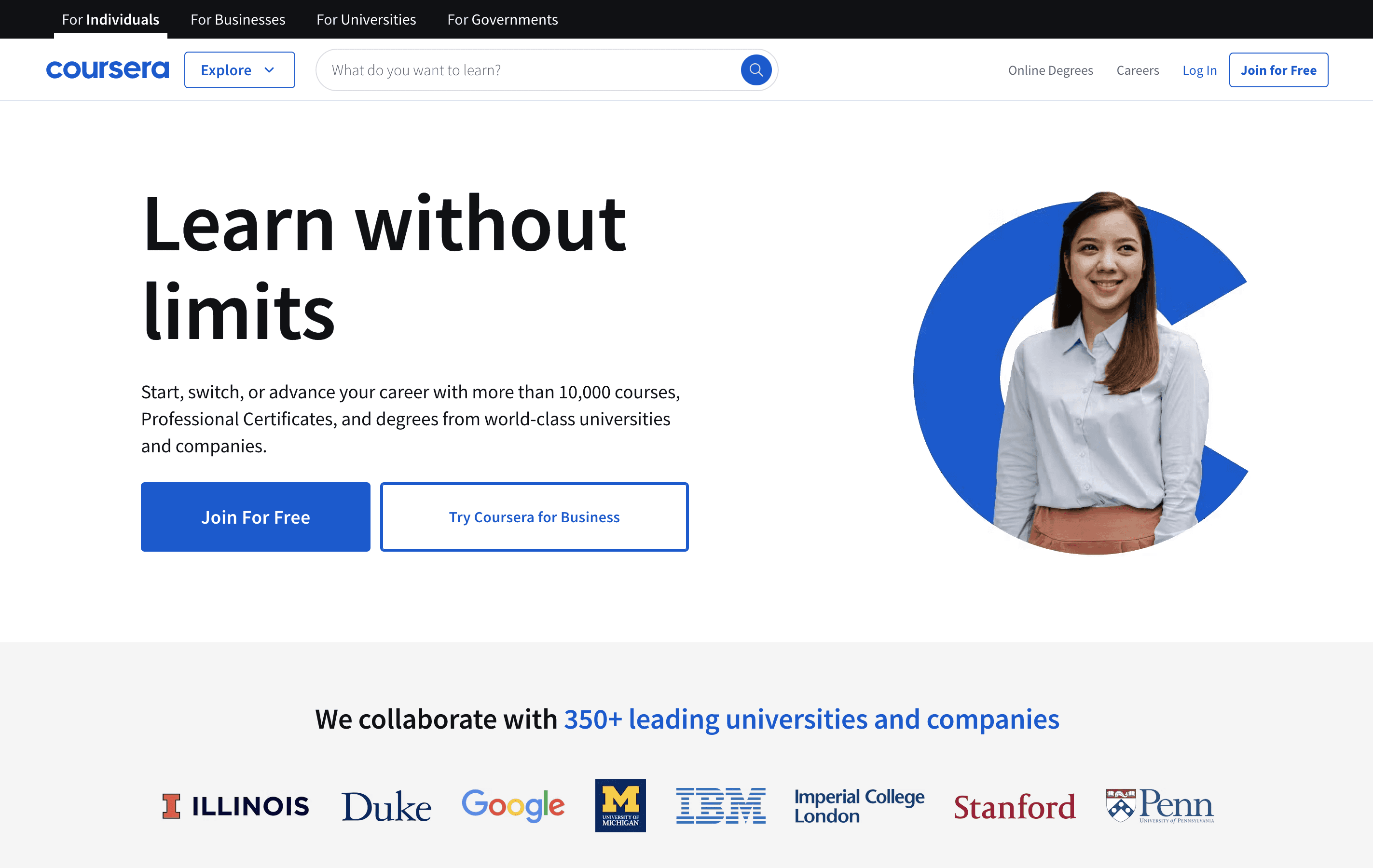
Increasing course completion rate on Coursera By personalized nudges & gamification elements
Team
2 Designers
Mentor
Tools
Figma, Figjam
Duration
5 Weeks
Problem
The Vanishing Learner Mystery: Why Do Coursera Users Drop Out?
It started with excitement, a new Coursera course, a fresh goal. But somewhere along the way, the motivation faded. Life got busy, lessons piled up, and the course tab quietly closed… for good.
If that happened to us—learners who wanted to show up—how many others were silently slipping away too?
This case study uncovers the story behind Coursera’s disappearing learners. Through user insights and design thinking, we explored what derails motivation—and how smart UX can bring learners back on track.
Assumption
What Are Learners Really Going Through?
To uncover the core issues, we tapped into the voice of learners by looking at both our personal experiences and broader trends in online education. Here’s what we found:
1
User Behavior and Personal Challenges
Factors related to individual habits, motivation, and learning preferences.
2
Course-Related Issues
Challenges arising from course content, structure, or difficulty level.
3
Platform-Related Issues
Technical or UX-related obstacles within the platform that may hinder course completion.
Desk Research
Why do users leave a course?
We searched social such as Google play , Twitter , Trust-pilot , Site-jabber to understand users comments about coursera
Shravan Transports
December 1, 2024
“Downloaded content won’t load after crossing a certain download limit. Hate that there is even a limit especially for a paid user.
Users prefer to be able to watch videos in any situation without internet or filtering if they are taking a course.
Jebe Schlossberg
13 minutes ago
“One of the worst, actually it is the worst for support. Paid for a course, could not access, asked for a rofund and then they declined. Open many support cases, they said to try multiple things which dian't work. And everytime 1 want to reply back to them I need to open another ticket. what a joke.”
User issues with the support team include complaints about lack of access to the course, non-refunds, ineffective troubleshooting, and an inadequate ticketing system also User problems with payment and lack of notification of status after taking the course
u/bittersweetsymphoni
2 month ago
“They say on their website that it takes 7 months studying at 10 hours per week or something. IT TOOK ME 6 MONTHS AND I STUDIED 8 HOURS EVERY DAY(sometimes 12 hours a day on longer study sessions). Man I’m slow. I think I have a learning disability guys. Also, English is not my first language. Background; I have a psychology degree and did not study programming in university.”
The length of the course causes fatigue and loss of motivation.
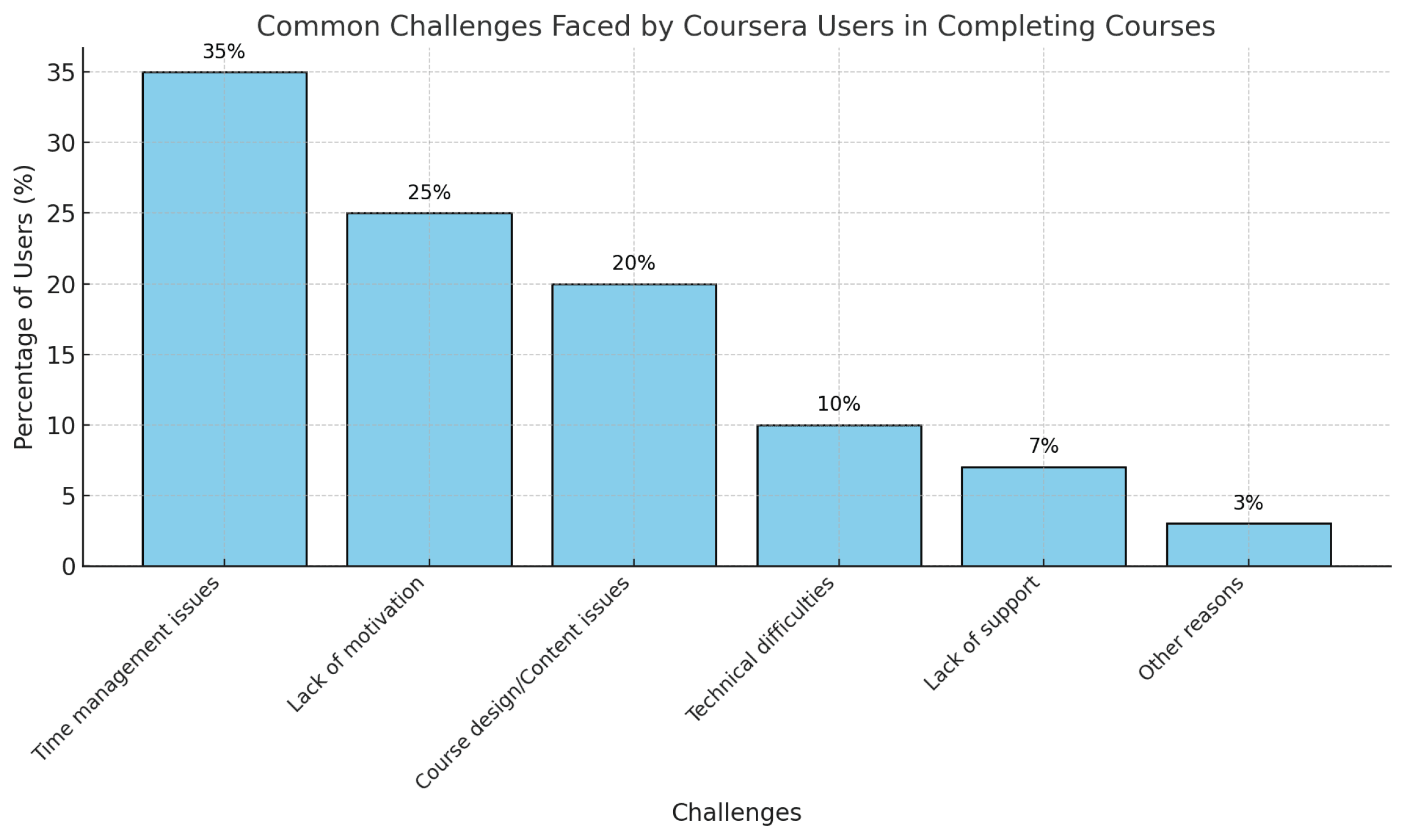
This chart shows how users’ difficulties completing online courses like Coursera are distributed.
Time management
35%
Lack of Motivation
25%
Course Design Issues
20%
Technical Issues
10%
Lack of Support
7%
Other Reasosn
3%
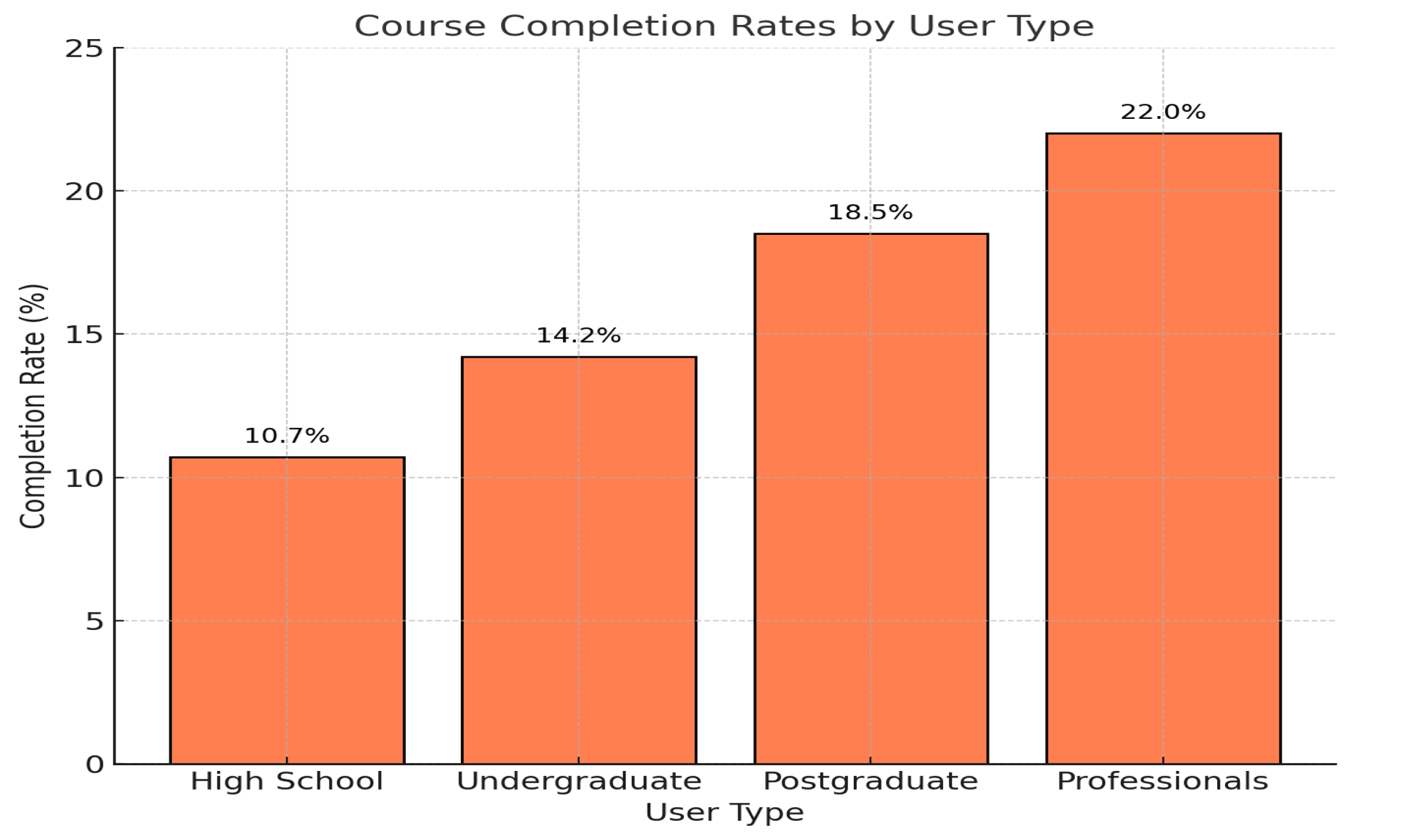
Course completion rates by user type:
Users advance in their careers , professional certifications
22%
Users with a master’s degree
18.5%
bachelor's degree students
14.2%
Technical Issues
10.7%
Interview + Insights
Users Needs and Pain points
After conducting interviews with 9 Coursera users, we uncovered several recurring themes that explain why learners struggle to complete their courses.
Short and concentrated courses that help users achieve their goals faster.
Options to message instructors or access a Q&A system to clarify doubts
Courses tailored to each user’s level, goals, and needs
Exercises and projects that are practical and applicable
Dividing courses into beginner, intermediate, and advanced levels
Courses are either too slow or overly superficial, lacking the necessary depth and details.
Users cannot ask questions or receive direct guidance from instructors.
Fixed course formats do not align with the diverse needs of users
Many learners struggle with effective time managemen
Users often drop out due to not having support and assistant.

Persona
So... Who are our users?
To personalize the learning experience, we created user personas based on real data from interviews. These personas represent diverse challenges and unique needs that learners face:

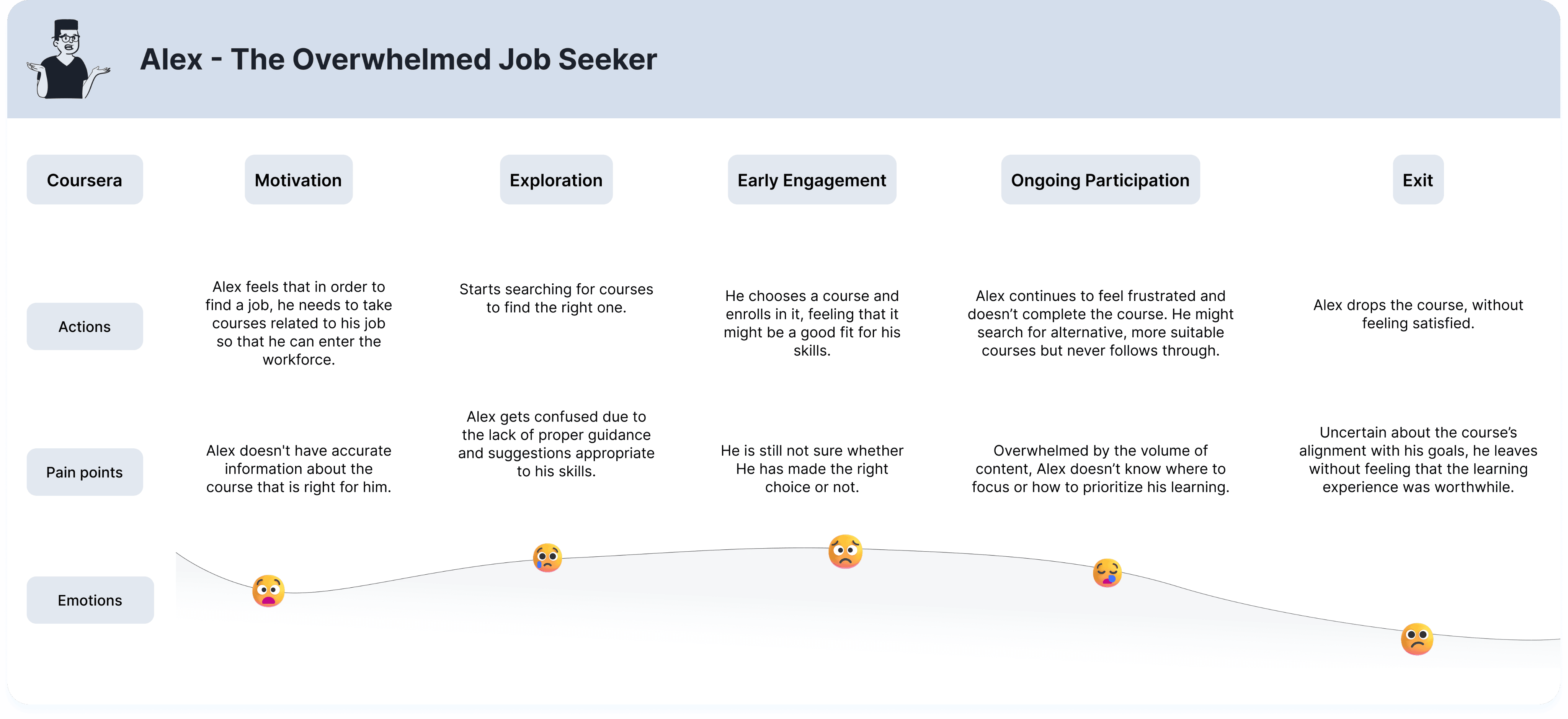
Alex - The Overwhelmed Job Seeker
Alex is determined to land his first job but feels overwhelmed and unsure after just a few modules in a digital marketing course, losing confidence in his decision.
Alex feels anxious and lost, questioning his choice and battling self-doubt about his career path.

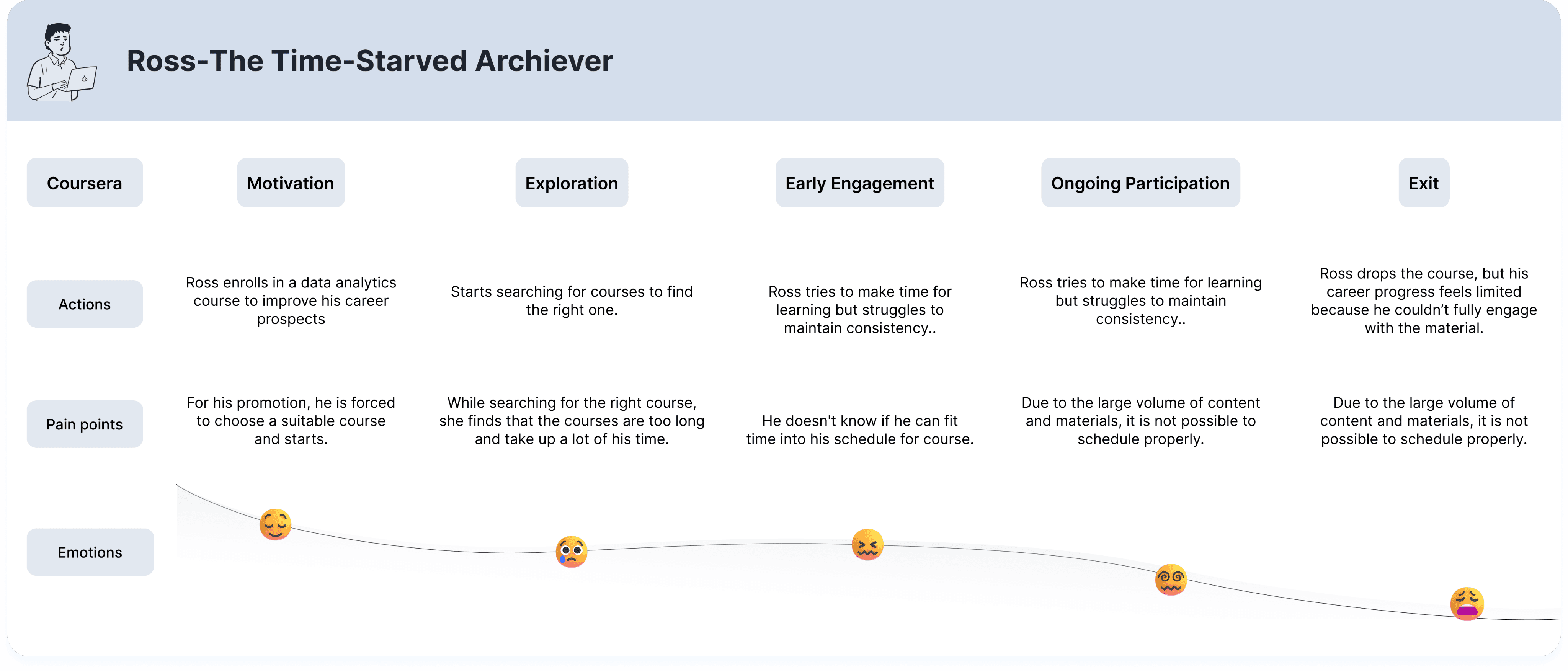
Ross – The Time-Starved Achiever
Ross starts a data analytics course to advance his career but struggles to keep up with the long, rigid sessions due to his hectic schedule, eventually giving up.
Ross feels guilty and frustrated, unable to balance his learning with his responsibilities, and his passion for career growth is overshadowed by time pressure and a sense of failure.

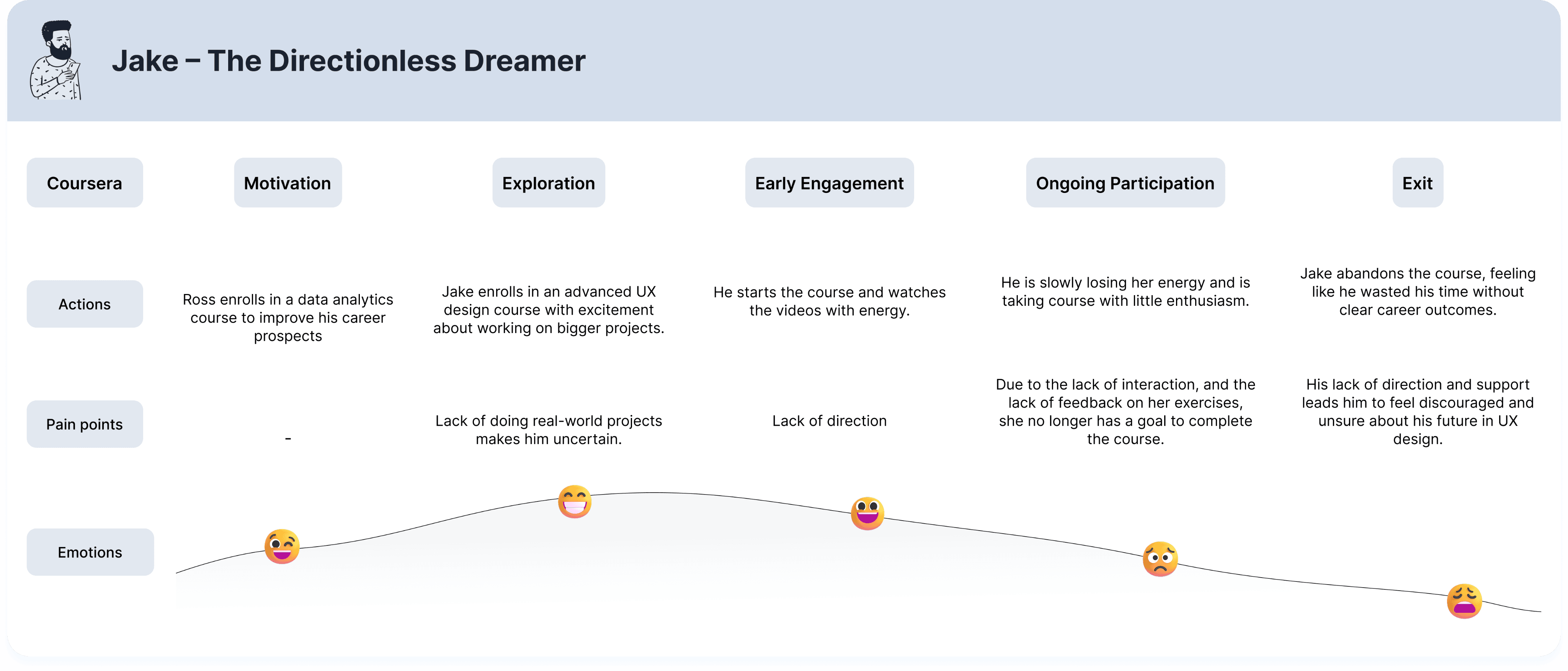
Jake – The Directionless Dreamer
Jake enrolls in an advanced UX design course but becomes confused and unfocused as he realizes he lacks clear career goals, ultimately dropping out.
Jake feels lost and discouraged unsure how to apply his skills in the real world, and the lack of a clear plan leaves him feeling stuck
Competitive Analaysis
What are competitors doing right?
We took a deep dive into how competitors like Udemy, LinkedIn Learning, and Skillshare are addressing engagement and retention, and their strategies revealed critical insights.
recommendation systems to suggest relevant courses based on user profiles and interests

Udemy
provide clear learning pathways

IDF

edx

data camp
offer self-paced courses with lifetime access to content

skill share
edx
Udemy
design shorter, more focused courses, enabling users to achieve their goals in a shorter timeframe
skill share
edx
data camp
providing Q&A systems
IDF
skill share
edx
data camp
connect with instructors
IDF
skill share
edx
data camp
Journey Map
Reviewing How Learners Engage with Coursera and Drop out Before Completion
HMW
Reimagining the Learning Experience: How Can We Prevent Dropouts?
Based on the insights gained, we formulated several “How Might We” questions to rethink how Coursera could re-engage learners and reduce dropouts:
HMW create a supportive and interactive learning experience that helps users feel connected, guided, and engaged throughout their journey?
HMW create a personalized and flexible course structure for users so that they can manage their time better and stay consistent
HMW motivate the Coursera learners so that they keep a clear goal in mind during their learning journey and not lose motivation half way through the course?
Ideation
Brainstorming on all possible solutions to the user problems we detected.
We brainstormed several innovative features to tackle the challenges learners face and chose the ones which had the medium effort and medium to high impact :

Final Ideas
After giving a lot of ideation , we choose these ideas.
1
Mistake-Based Feedback & Practice System
2
Gamified Rewards & Leveling System
3
Tool Integrations
4
Custom Motivational Alerts
Design
Turning ideas into action
After selecting the most impactful ideas from the Impact-Effort Matrix, we moved quickly to transform them into tangible UI designs.
1
Mistake-Based Feedback & Practice System
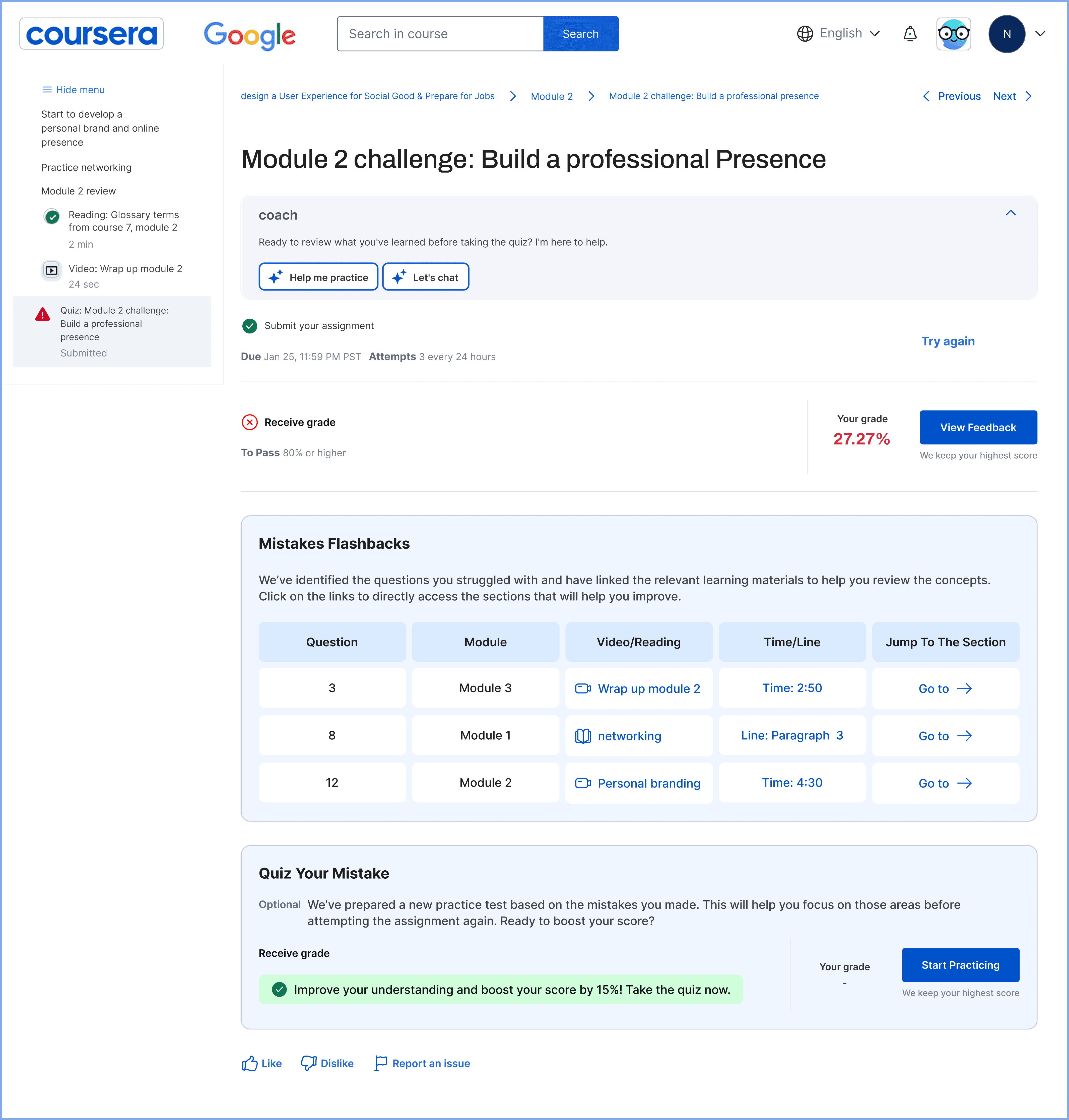
Immediate feedback on mistakes would encourage learners to reflect on errors, improving retention and engagement.
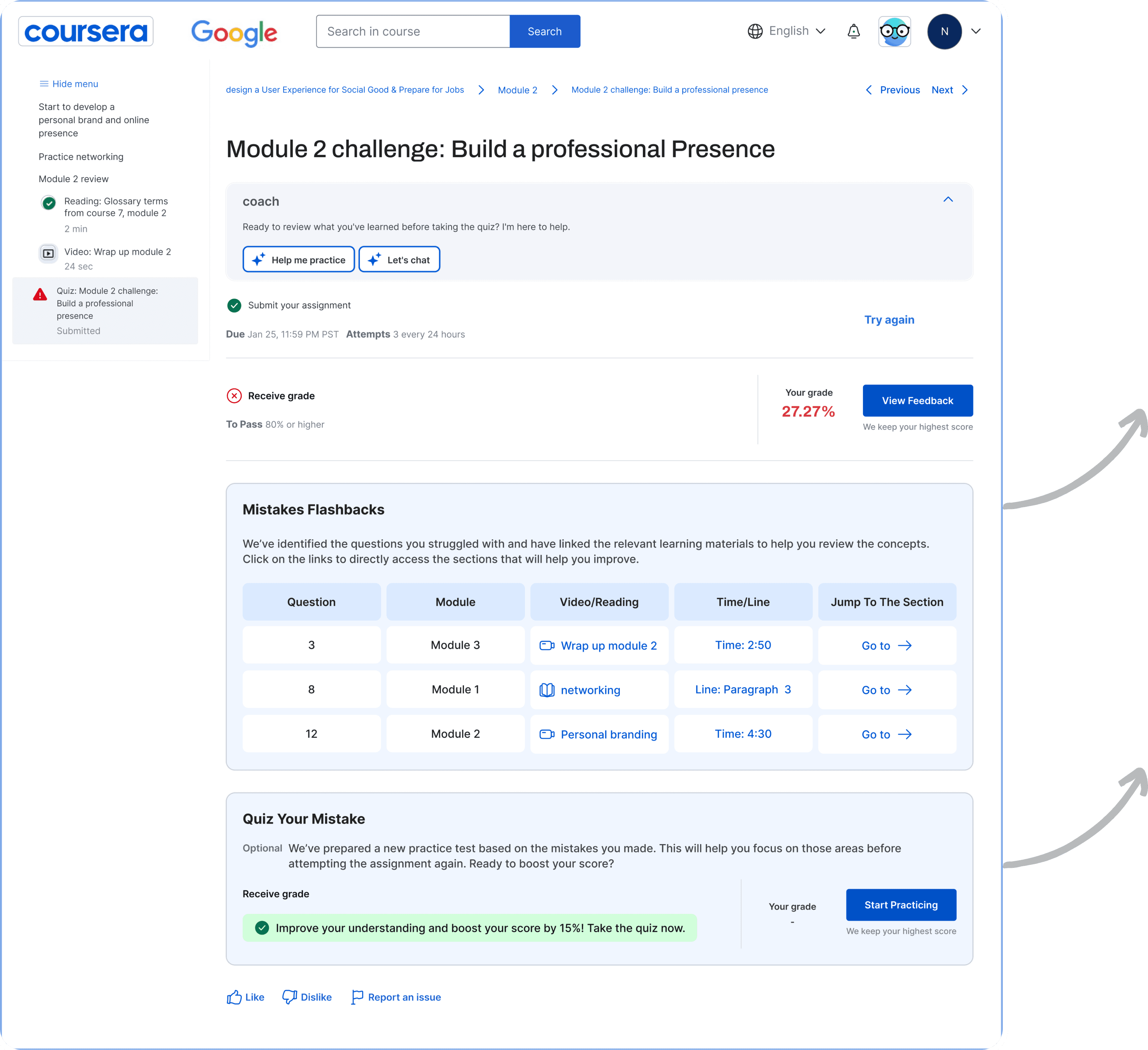
After a user fails the module’s quiz, we identify the questions they got wrong and provide direct links to the relevant learning materials.
Additionally, we generate a personalized practice quiz focused on their mistakes. This approach helps users regain confidence, reinforce their understanding, and improve their scores, encouraging them to continue learning instead of feeling discouraged.
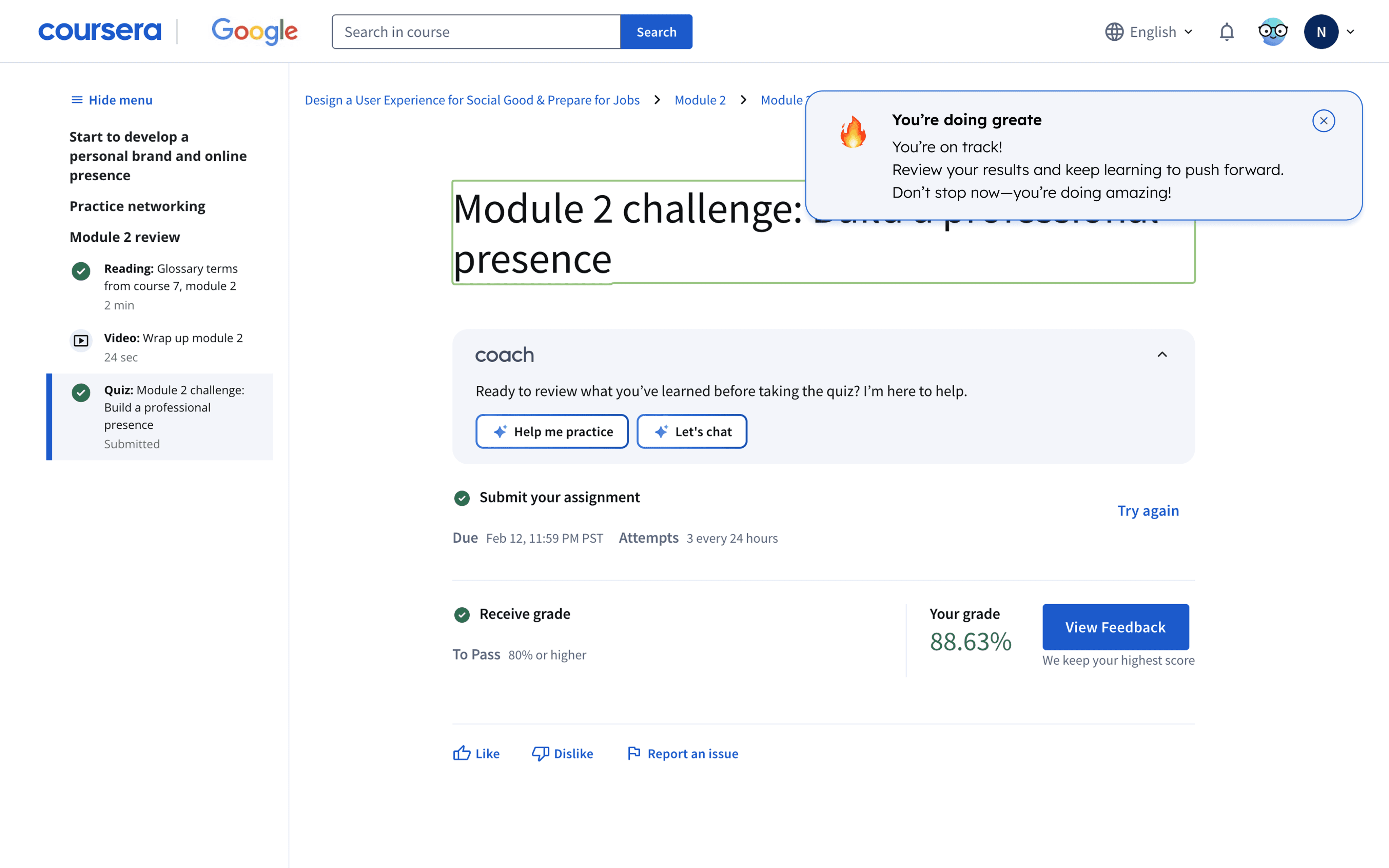
2
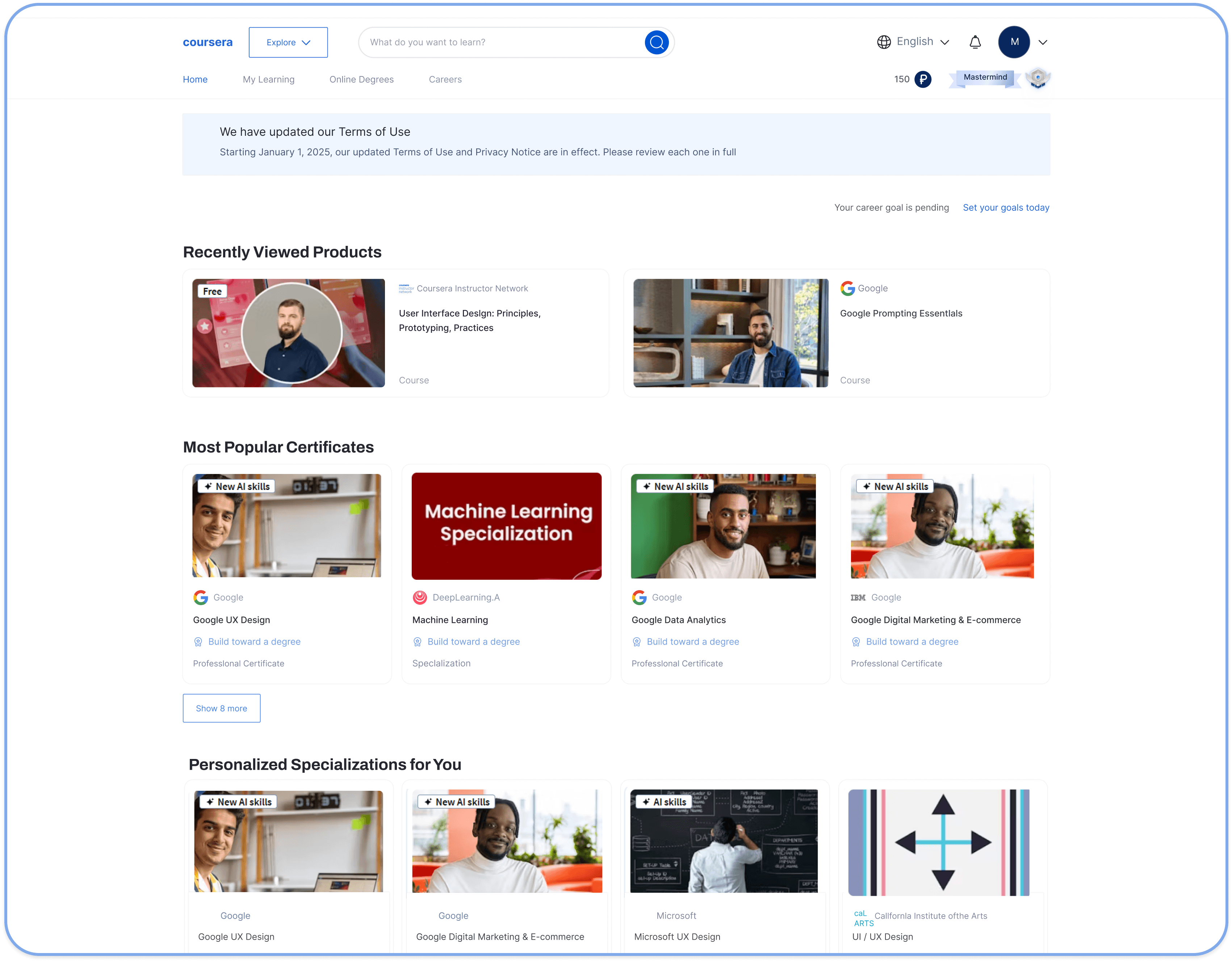
Gamified Rewards & Leveling System
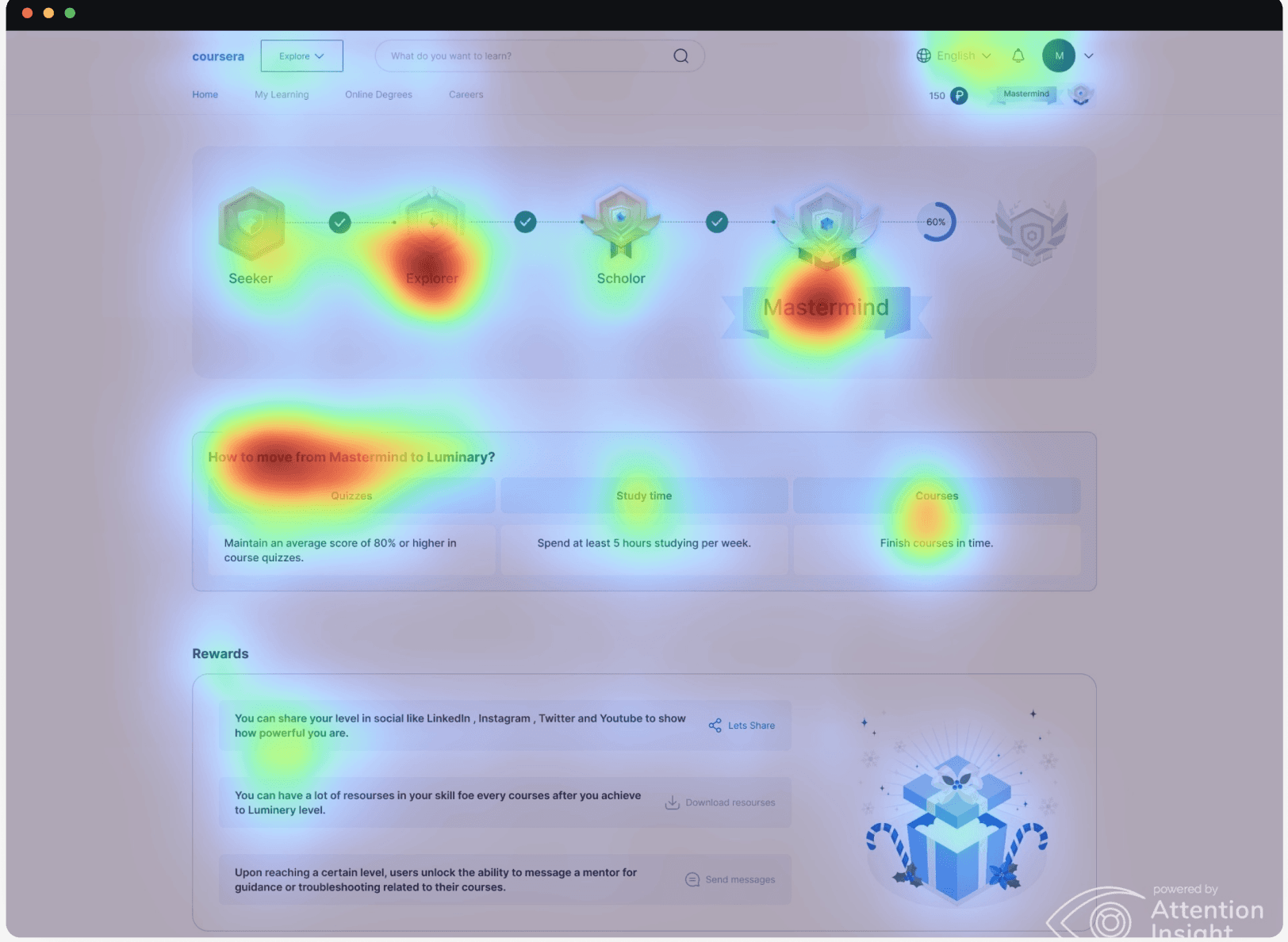
Introducing a grading system with rewards and leveling-up would create a sense of accomplishment and motivate learners to keep going.
Before
After

3
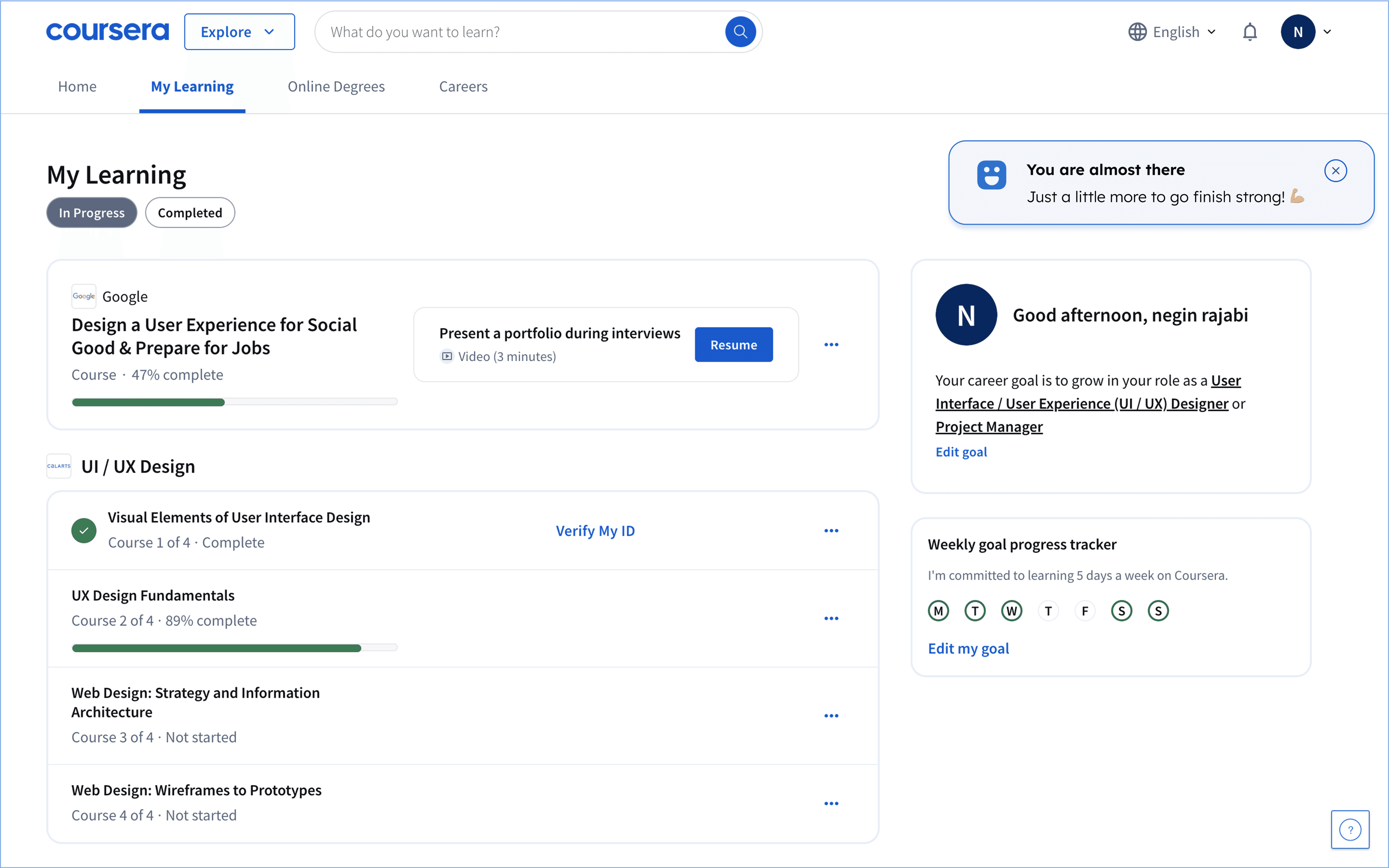
Custom Motivational Alerts
By providing personalized motivational alerts based on learner progress, engagement, and achievements, we can encourage consistency, celebrate milestones, and keep learners motivated throughout their journey.
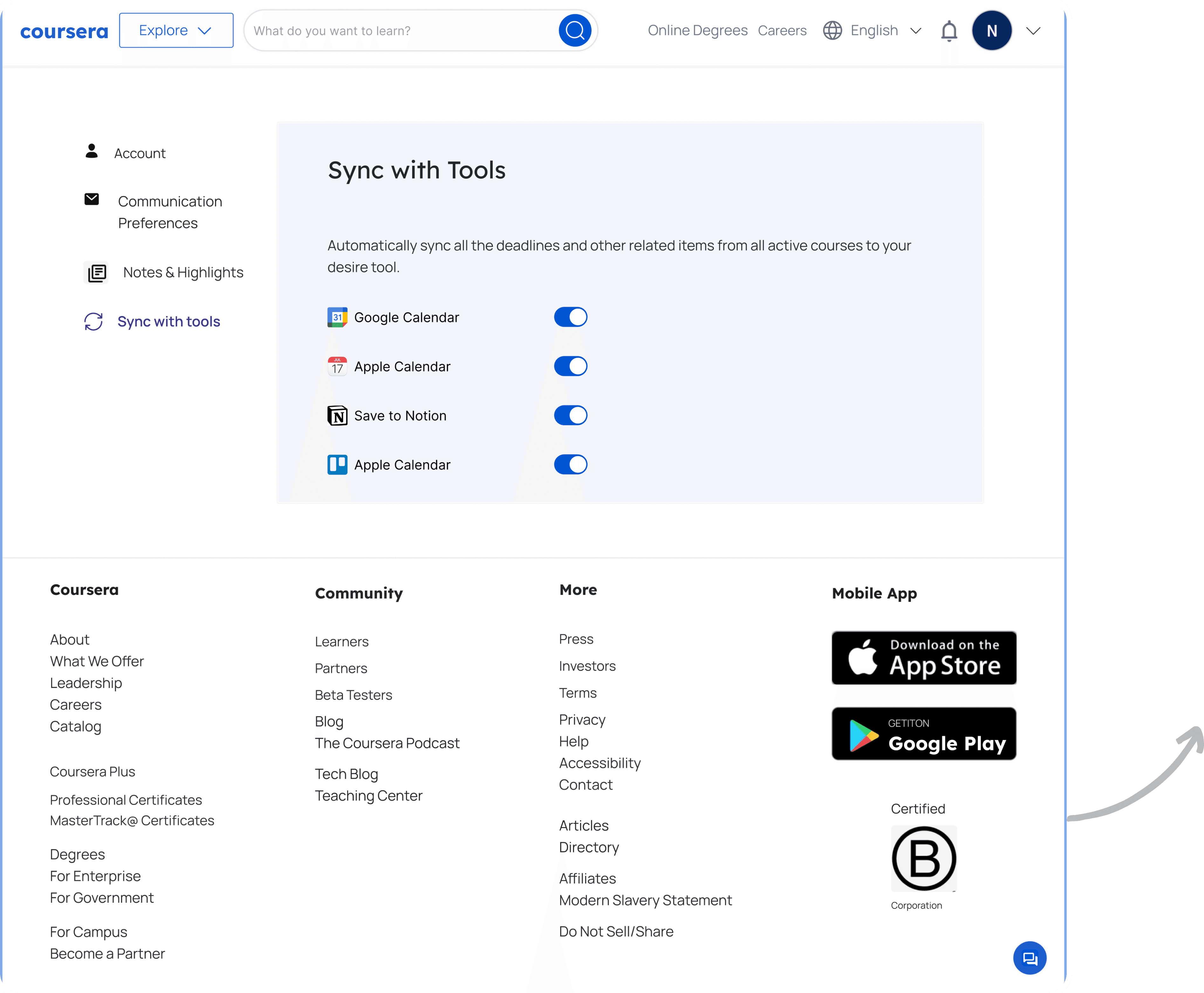
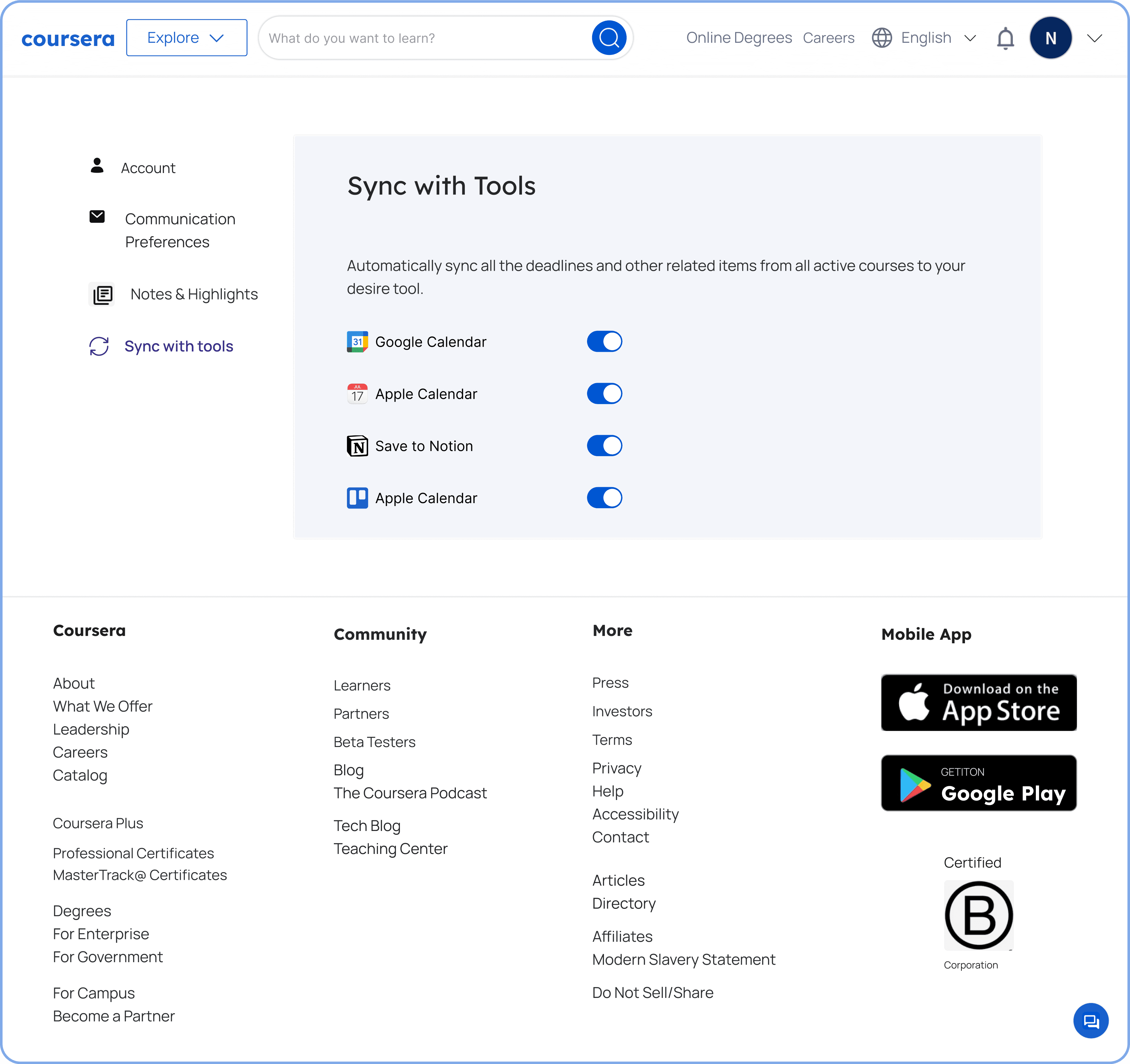
Many learners struggle to manage their time effectively, leading to missed deadlines and disengagement. By offering more syncing options, we allow users to integrate their coursework into the tools they already use and trust, helping them stay organized and reduce the pressure of balancing their learning with other responsibilities.
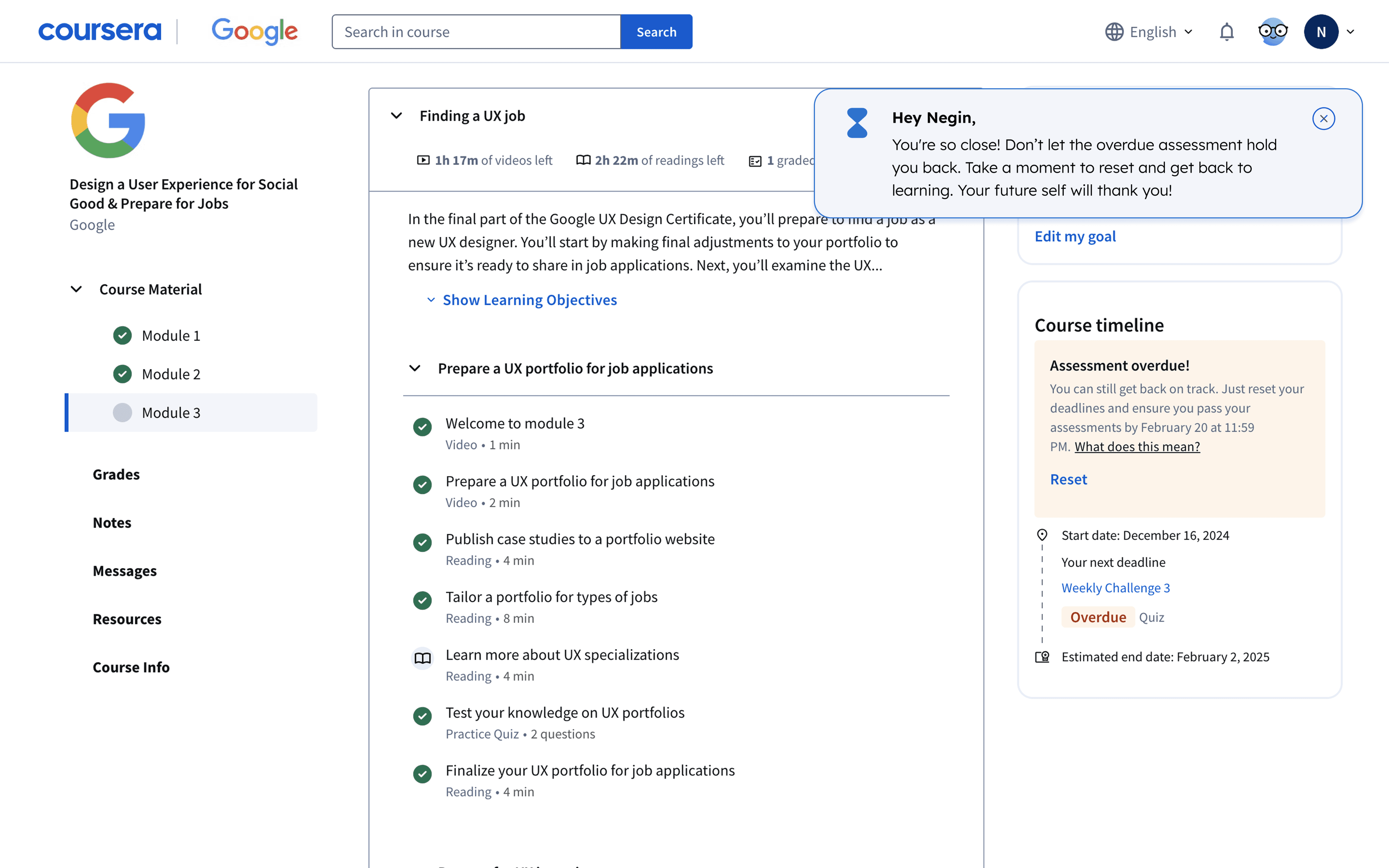
4
Custom Motivational Alerts
By providing personalized motivational alerts based on learner progress, engagement, and achievements, we can encourage consistency, celebrate milestones, and keep learners motivated throughout their journey.

Analyze
Did New Features Keep Learners Hooked?
After implementing the changes, we ran several tests to evaluate how well these features resonated with users:
5-Second Test
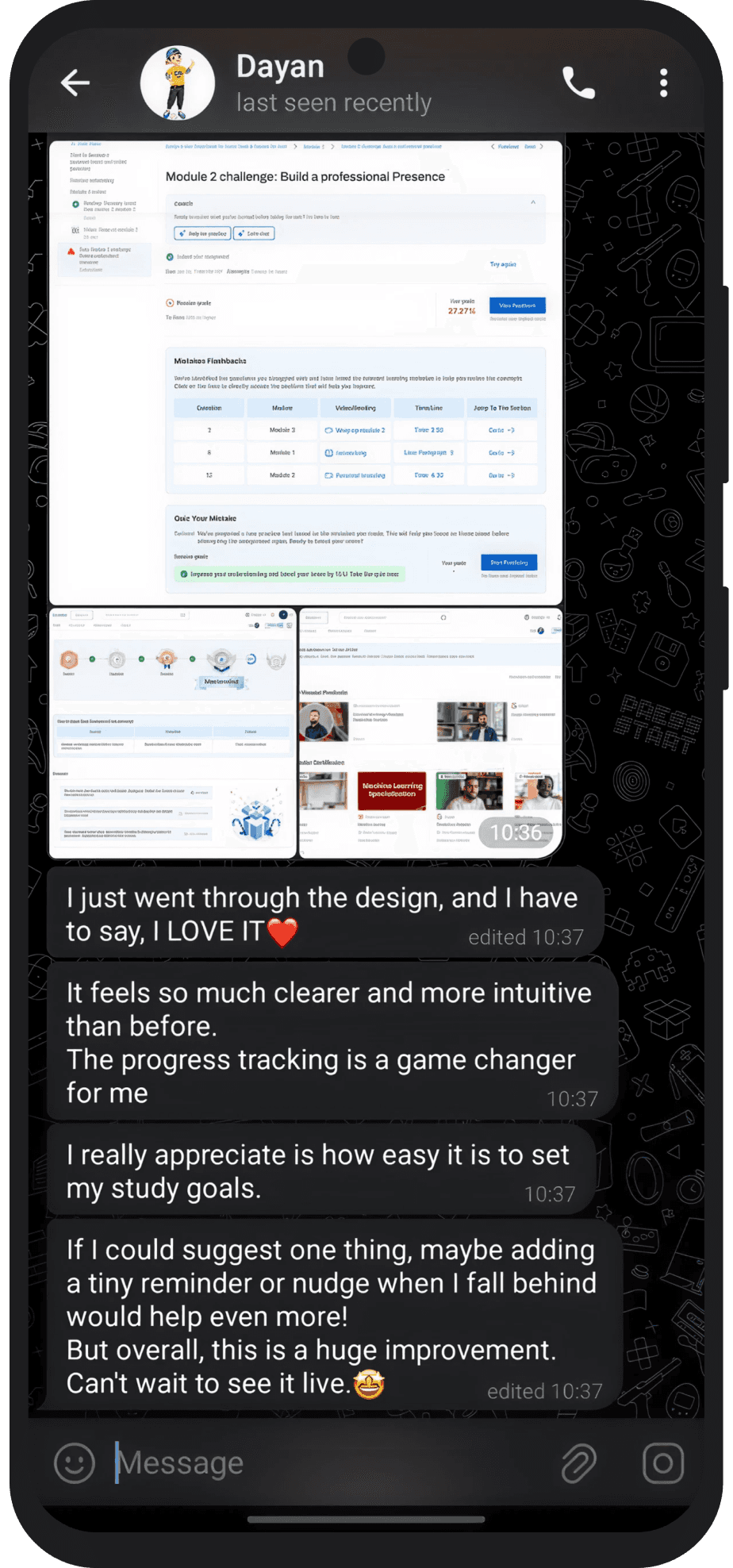
The results were promising—users immediately grasped the new features and were excited to engage.
Qualitative Feedback
Learners appreciated the gamification elements and felt more motivated, noting the ability to track progress and receive rewards as well as mistakes flashbacks which makes them to correct and learn their mistakes in the same time.
We reached this results after multiple rounds of user feedback and UI improvements.
What We learned
A New Kind of Learning Experience
The reasons for dropping out of a course vary for each user, and generic solutions are not effective enough. Personalized systems based on user behavior and needs are more practical.
When users make a commitment at the time of enrollment—such as setting a weekly study goal or choosing specific days for learning—they are more likely to stay engaged and complete the course.
We discovered that a user’s perceived progress is more important than their actual progress. Even if a learner hasn’t achieved deep mastery, they are more likely to continue if they feel they are on the right track. That’s why features like progress tracking, level indicators, completion percentages, and small achievements can significantly boost motivation.
Initially, we focused on problems that arise after starting a course, but we realized that how a user enters a course greatly impacts completion rates.
Thank You
For Watching
Problem
The Vanishing Learner Mystery: Why Do Coursera Users Drop Out?
It started with excitement, a new Coursera course, a fresh goal. But somewhere along the way, the motivation faded. Life got busy, lessons piled up, and the course tab quietly closed… for good.
If that happened to us—learners who wanted to show up—how many others were silently slipping away too?
This case study uncovers the story behind Coursera’s disappearing learners. Through user insights and design thinking, we explored what derails motivation—and how smart UX can bring learners back on track.
Assumption
What Are Learners Really Going Through?
To uncover the core issues, we tapped into the voice of learners by looking at both our personal experiences and broader trends in online education. Here’s what we found:
1
User Behavior and Personal Challenges
Factors related to individual habits, motivation, and learning preferences.
2
Course-Related Issues
Challenges arising from course content, structure, or difficulty level.
3
Platform-Related Issues
Technical or UX-related obstacles within the platform that may hinder course completion.
Desk Research
Why do users leave a course?
We searched social such as Google play , Twitter , Trust-pilot , Site-jabber to understand users comments about coursera
Shravan Transports
December 1, 2024
“Downloaded content won’t load after crossing a certain download limit. Hate that there is even a limit especially for a paid user.
Users prefer to be able to watch videos in any situation without internet or filtering if they are taking a course.
Jebe Schlossberg
13 minutes ago
“One of the worst, actually it is the worst for support. Paid for a course, could not access, asked for a rofund and then they declined. Open many support cases, they said to try multiple things which dian't work. And everytime 1 want to reply back to them I need to open another ticket. what a joke.”
User issues with the support team include complaints about lack of access to the course, non-refunds, ineffective troubleshooting, and an inadequate ticketing system also User problems with payment and lack of notification of status after taking the course
u/bittersweetsymphoni
2 month ago
“They say on their website that it takes 7 months studying at 10 hours per week or something. IT TOOK ME 6 MONTHS AND I STUDIED 8 HOURS EVERY DAY(sometimes 12 hours a day on longer study sessions). Man I’m slow. I think I have a learning disability guys. Also, English is not my first language. Background; I have a psychology degree and did not study programming in university.”
The length of the course causes fatigue and loss of motivation.
This chart shows how users’ difficulties completing online courses like Coursera are distributed.
Time management
35%
Lack of Motivation
25%
Course Design Issues
20%
Technical Issues
10%
Lack of Support
7%
Other Reasosn
3%
Course completion rates by user type:
Users advance in their careers , professional certifications
22%
Users with a master’s degree
18.5%
bachelor's degree students
14.2%
Technical Issues
10.7%
Interview + Insights
Users Needs and Pain points
After conducting interviews with 9 Coursera users, we uncovered several recurring themes that explain why learners struggle to complete their courses.
Short and concentrated courses that help users achieve their goals faster.
Options to message instructors or access a Q&A system to clarify doubts
Courses tailored to each user’s level, goals, and needs
Exercises and projects that are practical and applicable
Dividing courses into beginner, intermediate, and advanced levels
Courses are either too slow or overly superficial, lacking the necessary depth and details.
Users cannot ask questions or receive direct guidance from instructors.
Fixed course formats do not align with the diverse needs of users
Many learners struggle with effective time managemen
Users often drop out due to not having support and assistant.
Persona
So... Who are our users?
To personalize the learning experience, we created user personas based on real data from interviews. These personas represent diverse challenges and unique needs that learners face:
Alex - The Overwhelmed Job Seeker
Alex is determined to land his first job but feels overwhelmed and unsure after just a few modules in a digital marketing course, losing confidence in his decision.
Alex feels anxious and lost, questioning his choice and battling self-doubt about his career path.
Ross – The Time-Starved Achiever
Ross starts a data analytics course to advance his career but struggles to keep up with the long, rigid sessions due to his hectic schedule, eventually giving up.
Ross feels guilty and frustrated, unable to balance his learning with his responsibilities, and his passion for career growth is overshadowed by time pressure and a sense of failure.
Jake – The Directionless Dreamer
Jake enrolls in an advanced UX design course but becomes confused and unfocused as he realizes he lacks clear career goals, ultimately dropping out.
Jake feels lost and discouraged unsure how to apply his skills in the real world, and the lack of a clear plan leaves him feeling stuck
Competitive Analaysis
What are competitors doing right?
We took a deep dive into how competitors like Udemy, LinkedIn Learning, and Skillshare are addressing engagement and retention, and their strategies revealed critical insights.
recommendation systems to suggest relevant courses based on user profiles and interests
Udemy
provide clear learning pathways
IDF
edx
data camp
offer self-paced courses with lifetime access to content
skill share
edx
Udemy
design shorter, more focused courses, enabling users to achieve their goals in a shorter timeframe
skill share
edx
data camp
providing Q&A systems
IDF
skill share
edx
data camp
connect with instructors
IDF
skill share
edx
data camp
Journey Map
Reviewing How Learners Engage with Coursera and Drop out Before Completion
HMW
Reimagining the Learning Experience: How Can We Prevent Dropouts?
Based on the insights gained, we formulated several “How Might We” questions to rethink how Coursera could re-engage learners and reduce dropouts:
HMW create a supportive and interactive learning experience that helps users feel connected, guided, and engaged throughout their journey?
HMW create a personalized and flexible course structure for users so that they can manage their time better and stay consistent
HMW motivate the Coursera learners so that they keep a clear goal in mind during their learning journey and not lose motivation half way through the course?
Ideation
Brainstorming on all possible solutions to the user problems we detected.
We brainstormed several innovative features to tackle the challenges learners face and chose the ones which had the medium effort and medium to high impact :
Final Ideas
After giving a lot of ideation , we choose these ideas.
1
Mistake-Based Feedback & Practice System
2
Gamified Rewards & Leveling System
3
Tool Integrations
4
Custom Motivational Alerts
Design
Turning ideas into action
After selecting the most impactful ideas from the Impact-Effort Matrix, we moved quickly to transform them into tangible UI designs.
1
Mistake-Based Feedback & Practice System
Immediate feedback on mistakes would encourage learners to reflect on errors, improving retention and engagement.
After a user fails the module’s quiz, we identify the questions they got wrong and provide direct links to the relevant learning materials.
Additionally, we generate a personalized practice quiz focused on their mistakes. This approach helps users regain confidence, reinforce their understanding, and improve their scores, encouraging them to continue learning instead of feeling discouraged.
2
Gamified Rewards & Leveling System
Introducing a grading system with rewards and leveling-up would create a sense of accomplishment and motivate learners to keep going.
Before
After
3
Custom Motivational Alerts
By providing personalized motivational alerts based on learner progress, engagement, and achievements, we can encourage consistency, celebrate milestones, and keep learners motivated throughout their journey.
Many learners struggle to manage their time effectively, leading to missed deadlines and disengagement. By offering more syncing options, we allow users to integrate their coursework into the tools they already use and trust, helping them stay organized and reduce the pressure of balancing their learning with other responsibilities.
4
Custom Motivational Alerts
By providing personalized motivational alerts based on learner progress, engagement, and achievements, we can encourage consistency, celebrate milestones, and keep learners motivated throughout their journey.
Analyze
Did New Features Keep Learners Hooked?
After implementing the changes, we ran several tests to evaluate how well these features resonated with users:
5-Second Test
The results were promising—users immediately grasped the new features and were excited to engage.
Qualitative Feedback
Learners appreciated the gamification elements and felt more motivated, noting the ability to track progress and receive rewards as well as mistakes flashbacks which makes them to correct and learn their mistakes in the same time.
We reached this results after multiple rounds of user feedback and UI improvements.
What We learned
A New Kind of Learning Experience
The reasons for dropping out of a course vary for each user, and generic solutions are not effective enough. Personalized systems based on user behavior and needs are more practical.
When users make a commitment at the time of enrollment—such as setting a weekly study goal or choosing specific days for learning—they are more likely to stay engaged and complete the course.
We discovered that a user’s perceived progress is more important than their actual progress. Even if a learner hasn’t achieved deep mastery, they are more likely to continue if they feel they are on the right track. That’s why features like progress tracking, level indicators, completion percentages, and small achievements can significantly boost motivation.
Initially, we focused on problems that arise after starting a course, but we realized that how a user enters a course greatly impacts completion rates.
Thank You
For Watching
Problem
The Vanishing Learner Mystery: Why Do Coursera Users Drop Out?
It started with excitement, a new Coursera course, a fresh goal. But somewhere along the way, the motivation faded. Life got busy, lessons piled up, and the course tab quietly closed… for good.
If that happened to us—learners who wanted to show up—how many others were silently slipping away too?
This case study uncovers the story behind Coursera’s disappearing learners. Through user insights and design thinking, we explored what derails motivation—and how smart UX can bring learners back on track.
Assumption
What Are Learners Really Going Through?
To uncover the core issues, we tapped into the voice of learners by looking at both our personal experiences and broader trends in online education. Here’s what we found:
1
User Behavior and Personal Challenges
Factors related to individual habits, motivation, and learning preferences.
2
Course-Related Issues
Challenges arising from course content, structure, or difficulty level.
3
Platform-Related Issues
Technical or UX-related obstacles within the platform that may hinder course completion.
Desk Research
Why do users leave a course?
We searched social such as Google play , Twitter , Trust-pilot , Site-jabber to understand users comments about coursera
Shravan Transports
December 1, 2024
“Downloaded content won’t load after crossing a certain download limit. Hate that there is even a limit especially for a paid user.
Users prefer to be able to watch videos in any situation without internet or filtering if they are taking a course.
Jebe Schlossberg
13 minutes ago
“One of the worst, actually it is the worst for support. Paid for a course, could not access, asked for a rofund and then they declined. Open many support cases, they said to try multiple things which dian't work. And everytime 1 want to reply back to them I need to open another ticket. what a joke.”
User issues with the support team include complaints about lack of access to the course, non-refunds, ineffective troubleshooting, and an inadequate ticketing system also User problems with payment and lack of notification of status after taking the course
u/bittersweetsymphoni
2 month ago
“They say on their website that it takes 7 months studying at 10 hours per week or something. IT TOOK ME 6 MONTHS AND I STUDIED 8 HOURS EVERY DAY(sometimes 12 hours a day on longer study sessions). Man I’m slow. I think I have a learning disability guys. Also, English is not my first language. Background; I have a psychology degree and did not study programming in university.”
The length of the course causes fatigue and loss of motivation.
This chart shows how users’ difficulties completing online courses like Coursera are distributed.
Time management
35%
Lack of Motivation
25%
Course Design Issues
20%
Technical Issues
10%
Lack of Support
7%
Other Reasosn
3%
Course completion rates by user type:
Users advance in their careers , professional certifications
22%
Users with a master’s degree
18.5%
bachelor's degree students
14.2%
Technical Issues
10.7%
Interview + Insights
Users Needs and Pain points
After conducting interviews with 9 Coursera users, we uncovered several recurring themes that explain why learners struggle to complete their courses.
Short and concentrated courses that help users achieve their goals faster.
Options to message instructors or access a Q&A system to clarify doubts
Courses tailored to each user’s level, goals, and needs
Exercises and projects that are practical and applicable
Dividing courses into beginner, intermediate, and advanced levels
Courses are either too slow or overly superficial, lacking the necessary depth and details.
Users cannot ask questions or receive direct guidance from instructors.
Fixed course formats do not align with the diverse needs of users
Many learners struggle with effective time managemen
Users often drop out due to not having support and assistant.
Persona
So... Who are our users?
To personalize the learning experience, we created user personas based on real data from interviews. These personas represent diverse challenges and unique needs that learners face:
Alex - The Overwhelmed Job Seeker
Alex is determined to land his first job but feels overwhelmed and unsure after just a few modules in a digital marketing course, losing confidence in his decision.
Alex feels anxious and lost, questioning his choice and battling self-doubt about his career path.
Ross – The Time-Starved Achiever
Ross starts a data analytics course to advance his career but struggles to keep up with the long, rigid sessions due to his hectic schedule, eventually giving up.
Ross feels guilty and frustrated, unable to balance his learning with his responsibilities, and his passion for career growth is overshadowed by time pressure and a sense of failure.
Jake – The Directionless Dreamer
Jake enrolls in an advanced UX design course but becomes confused and unfocused as he realizes he lacks clear career goals, ultimately dropping out.
Jake feels lost and discouraged unsure how to apply his skills in the real world, and the lack of a clear plan leaves him feeling stuck
Competitive Analaysis
What are competitors doing right?
We took a deep dive into how competitors like Udemy, LinkedIn Learning, and Skillshare are addressing engagement and retention, and their strategies revealed critical insights.
recommendation systems to suggest relevant courses based on user profiles and interests
Udemy
provide clear learning pathways
IDF
edx
data camp
offer self-paced courses with lifetime access to content
skill share
edx
Udemy
design shorter, more focused courses, enabling users to achieve their goals in a shorter timeframe
skill share
edx
data camp
providing Q&A systems
IDF
skill share
edx
data camp
connect with instructors
IDF
skill share
edx
data camp
Journey Map
Reviewing How Learners Engage with Coursera and Drop out Before Completion
HMW
Reimagining the Learning Experience: How Can We Prevent Dropouts?
Based on the insights gained, we formulated several “How Might We” questions to rethink how Coursera could re-engage learners and reduce dropouts:
HMW create a supportive and interactive learning experience that helps users feel connected, guided, and engaged throughout their journey?
HMW create a personalized and flexible course structure for users so that they can manage their time better and stay consistent
HMW motivate the Coursera learners so that they keep a clear goal in mind during their learning journey and not lose motivation half way through the course?
Ideation
Brainstorming on all possible solutions to the user problems we detected.
We brainstormed several innovative features to tackle the challenges learners face and chose the ones which had the medium effort and medium to high impact :
Final Ideas
After giving a lot of ideation , we choose these ideas.
1
Mistake-Based Feedback & Practice System
2
Gamified Rewards & Leveling System
3
Tool Integrations
4
Custom Motivational Alerts
Design
Turning ideas into action
After selecting the most impactful ideas from the Impact-Effort Matrix, we moved quickly to transform them into tangible UI designs.
1
Mistake-Based Feedback & Practice System
Immediate feedback on mistakes would encourage learners to reflect on errors, improving retention and engagement.
After a user fails the module’s quiz, we identify the questions they got wrong and provide direct links to the relevant learning materials.
Additionally, we generate a personalized practice quiz focused on their mistakes. This approach helps users regain confidence, reinforce their understanding, and improve their scores, encouraging them to continue learning instead of feeling discouraged.
2
Gamified Rewards & Leveling System
Introducing a grading system with rewards and leveling-up would create a sense of accomplishment and motivate learners to keep going.
3
Custom Motivational Alerts
By providing personalized motivational alerts based on learner progress, engagement, and achievements, we can encourage consistency, celebrate milestones, and keep learners motivated throughout their journey.
Many learners struggle to manage their time effectively, leading to missed deadlines and disengagement. By offering more syncing options, we allow users to integrate their coursework into the tools they already use and trust, helping them stay organized and reduce the pressure of balancing their learning with other responsibilities.
4
Custom Motivational Alerts
By providing personalized motivational alerts based on learner progress, engagement, and achievements, we can encourage consistency, celebrate milestones, and keep learners motivated throughout their journey.
Before
After
Analyze
Did New Features Keep Learners Hooked?
After implementing the changes, we ran several tests to evaluate how well these features resonated with users:
5-Second Test
The results were promising—users immediately grasped the new features and were excited to engage.
Qualitative Feedback
Learners appreciated the gamification elements and felt more motivated, noting the ability to track progress and receive rewards as well as mistakes flashbacks which makes them to correct and learn their mistakes in the same time.
We reached this results after multiple rounds of user feedback and UI improvements.
What We learned
A New Kind of Learning Experience
The reasons for dropping out of a course vary for each user, and generic solutions are not effective enough. Personalized systems based on user behavior and needs are more practical.
When users make a commitment at the time of enrollment—such as setting a weekly study goal or choosing specific days for learning—they are more likely to stay engaged and complete the course.
We discovered that a user’s perceived progress is more important than their actual progress. Even if a learner hasn’t achieved deep mastery, they are more likely to continue if they feel they are on the right track. That’s why features like progress tracking, level indicators, completion percentages, and small achievements can significantly boost motivation.
Initially, we focused on problems that arise after starting a course, but we realized that how a user enters a course greatly impacts completion rates.
Thank You
For Watching
Increasing course completion rate on Coursera By personalized nudges & gamification elements
Team
2 Designers
Mentor
Tools
Figma, Figjam
Duration
5 Weeks
Increasing course completion rate on Coursera By personalized nudges & gamification elements
Team
2 Designers
Mentor
Tools
Figma, Figjam
Duration
5 Weeks